Biography:
Dr. Sandford is a member of Ames' Astrophysics Branch and a senior member of Ames' Astrochemistry Laboratory. Dr. Sandford does extensive work in the areas of laboratory astrophysics and astrochemistry, and infrared astronomy (ground-based and airborne). He has used the combined techniques of infrared astronomy and laboratory astrophysics/astrochemistry to identify a number of new molecular species in space, many of interest to astrobiology (for example, organic compounds in the diffuse ISM). Current laboratory interests include the study of the physical, chemical, and spectroscopic properties of polycyclic aromatic hydrocarbons (PAHs) and astrophysical ice analogs relevant to interstellar, cometary, and planetary environments. Much of this work is centered on the study of the abiotic creation and evolution of organic compounds of astrobiological interest in a variety of astrophysical environments. Compounds that have been worked on in the laboratory include amino acids (the building blocks of proteins), the nucleobases (the building blocks of RNA and DNA), amphiphiles (the building blocks of membranes), sugars (the building blocks of carbohydrates), and quinones (oxidized aromatic compounds that play a host of roles in terrestrial living systems).
Dr. Sandford has extensive experience in the fields of meteoritics. He is an Associate Editor of the journal Meteoritics and Planetary Science and has helped find many meteorites in Antarctica, some of them quite famous — or perhaps infamous is a better word (for example, the martian meteorite ALH84001).
Dr. Sandford has the Principal Investigator on several concept missions designed to determine the nature, abundance, and distribution of organic materials in space. These include the Astrobiology SPace IR Explorer (ASPIRE) Astrophysics Strategic Mission concept, the AstroBiology Explorer (ABE) MIDEX Mission concept, and the Deuterium Explorer (DEX) SMEX Mission concept. These missions are cryogenically cooled infrared telescopes capable of measuring the mid-infrared spectra of a wide variety of objects and environments in space. These spectra will be used to understand the origin and evolution of organic compounds in space and time.
Dr. Sandford is also a Co-Investigator on several sample return missions. He is an original Co-Investigator on the STARDUST Discovery Mission that collected a sample from Comet Wild-2 and returned it safely to Earth! The STARDUST spacecraft was launched on February 7, 1999 and intercepted Comet Wild-2 in January of 2004. Images of the comet's nucleus can be seen here. The collected sample was returned to Earth for study on January 15, 2006. Dr. Sandford was on the Recovery Team that located and recovered the Sample Return Capsule after it fiery reentry into the Earth's atmosphere. He also escorted the capsule to Johnson Space Center and assisted with the removal of cometary samples from the collector. Dr. Sandford was also led the team of international scientists that carried out a preliminary examination of the organics in the returned samples. Click here to listen to Dr. Sandford answering questions about the STARDUST mission. Dr. Sandford is also the PI of a next generation comet sample return mission concept called CORSAIR (COmet Rendezvous, Sample Acquisition, Investigation, and Return) that was submitted to NASA for consideration for New Frontiers 4.
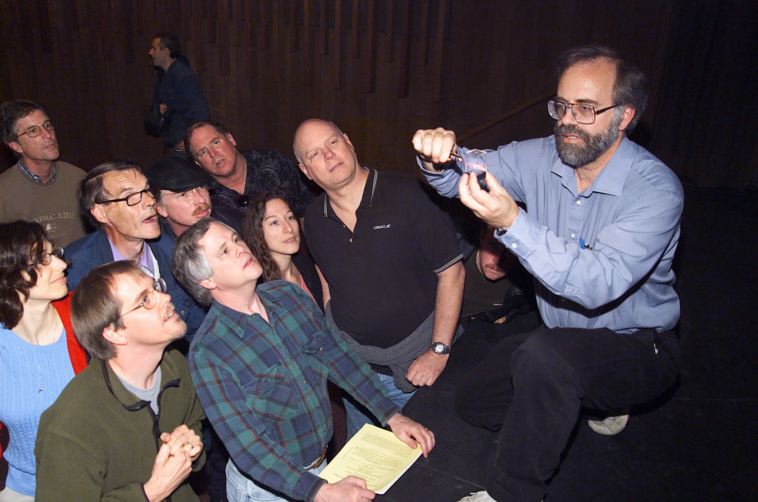
An image of Scott showing off a piece of Stardust aerogel, the material used in the Stardust Mission to catch the comet dust particles. Click to expand image.
Dr. Sandford was also a Co-Investigator on the Japanese led Hayabusa Mission. This mission retturned samples from the asteroid Itokawa to Earth for scientific study. Hayabusa obtained some spectacular images of this small asteroid.
Dr. Sandford is also a Co-Investigator on the OSIRIS-REx (Origins, Spectral Interpretation, Resource Identification, Security, and Regolith Explorer) New Frontiers mission. This mission will collect samples from the rare B-type asteroid Bennu and return them to Earth for study.
Dr. Sandford's major publications can be found on the Astrochemistry Laboratory's Publications Pages.
|